
Evidence-based brief on the export market for Indian eggs

India is primarily a domestic egg powerhouse (rapid production growth over the last 20–30 years) with exports concentrated to nearby / Gulf & South Asian markets and a growing niche trade in processed egg products (egg powder, Pasteurised/processed eggs).
2) Past (how India got here)
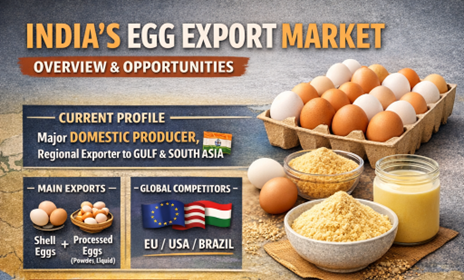
India’s egg sector shifted from largely backyard/household production to industrialised, commercial layer farming over the last 3–4 decades; by the early 2020s per-capita availability exceeded ~100 eggs per year and production scaled up dramatically. This domestic growth created a surplus in some states that enabled export flows to neighbouring and Gulf markets.
Historically, Indian exports were small relative to domestic output and focused on shell eggs and egg powder shipped to nearby markets such as Sri Lanka, Maldives, UAE, Oman and other Gulf and African buyers.
3) Present (current situation & volumes — headline facts)
Global trade in fresh eggs is sizeable and concentrated. Netherlands, USA, Poland, Turkey and EU members are the largest exporters by value/volume (Netherlands leads). India is not among the top global exporters by value but participates actively in regional trade.
India’s shipments (both shell eggs and egg powder) continue to serve Gulf/nearby markets and expand small but meaningful exports of egg powder and processed egg products. Recent industry data and trade platforms show thousands of shipments per year with month-to-month volatility.
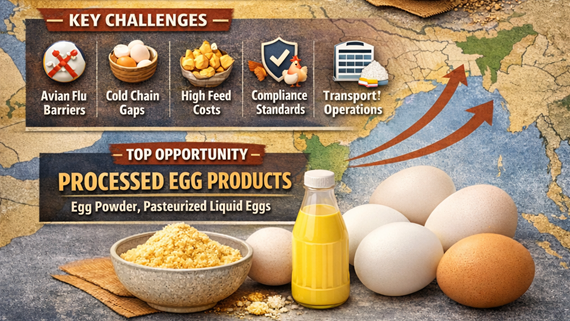
Key present constraints include sanitary barriers (avian influenza outbreaks and trade restrictions), cold-chain and cold-storage shortfalls, rising feed costs, and compliance/traceability requirements from importing countries.

4) Competitors — who India faces on world markets
European exporters (Netherlands, Poland, Italy, Belgium) dominate shell egg trade and value-added egg products due to advanced processing plants and strong disease controls.
United States is a large exporter of egg products, particularly for food-processing markets.
Brazil is an emerging and fast-growing exporter to the Middle East and some Asian markets.
Regional suppliers such as Turkey, Mexico and some Southeast Asian countries compete on price and logistics for Middle East and African buyers.
5) Future potential for Indian egg exports
Processed egg products (egg powder, pasteurised liquid egg, albumen) represent the strongest scalable opportunity due to longer shelf life, higher unit value and easier logistics.
Near-term demand exists in the Middle East, North Africa, neighbouring South Asian countries and parts of Africa.
Drivers include investment in cold chain and processing plants, stronger traceability and certification, consolidation of exporters and targeting food-processing clients.
6) Main risks & bottlenecks
Animal health trade barriers due to avian influenza outbreaks.
Limited cold chain and processing capacity.
Regulatory compliance and traceability challenges.
Feed cost volatility and price competitiveness.
7) Practical recommendations
Invest in breaking, pasteurizing and packaging lines for processed egg products.
Strengthen biosecurity, disease surveillance and exporter certification.
Focus on food-processing customers in Gulf, Africa and Southeast Asia.
Provide government support through subsidies, soft loans and export facilitation.
8) Takeaway
India is a major domestic egg producer but a small, regionally focused exporter. The most realistic growth path lies in processed egg products rather than bulk shell eggs.
Shared by:
V S Balasubramaniam, Namakkal