 HERO BANNER
This on-farm hatching concept has been described as revolutionary for broiler welfare and sustainability. How does egg transfer to hatch work?
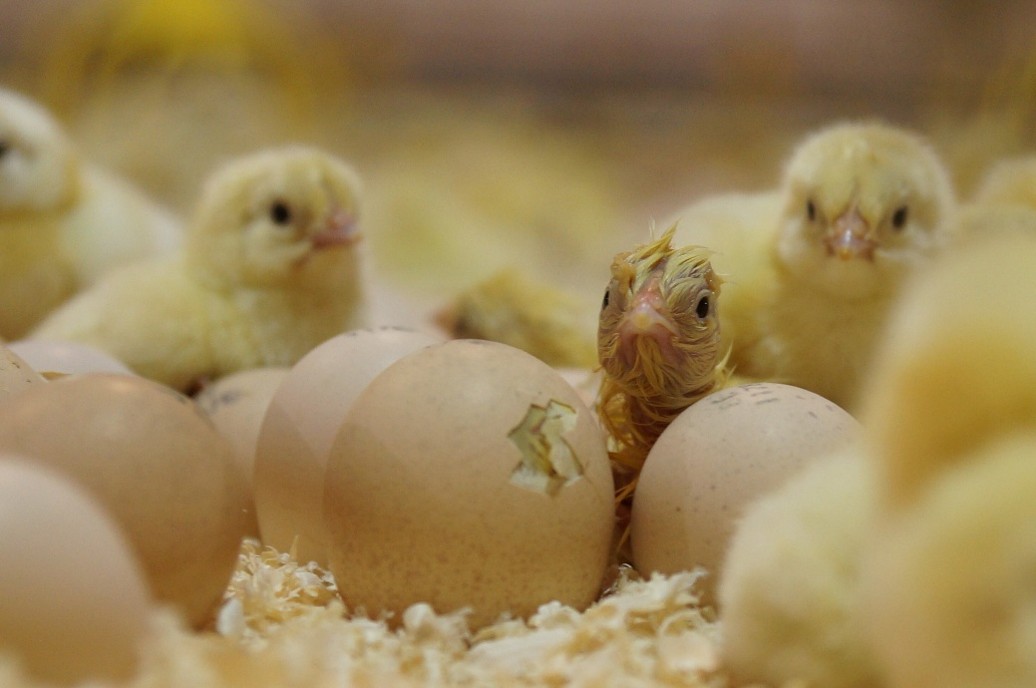
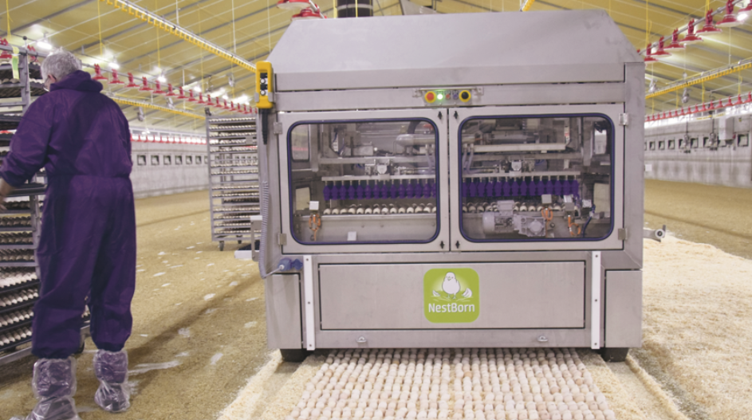
On-farm hatching with NestBorn is a revolutionary way to hatch chicks in a more future-proof way that’s quite different from hatching chicks in a traditional way. Our process takes the hatch away from the multi-challenged environment of the hatchery and allows the chicks to hatch in an undisturbed and more natural way in the broiler barn.
It's a very quick and efficient operation. A 40,000 day-old chick barn can be handled in less than one hour with only one or two operators, it's very labor friendly. After the eggs have been placed on the litter, the temperature of the barn will be at a similar level to the day-old chick's arrival (34°C or 93°F).
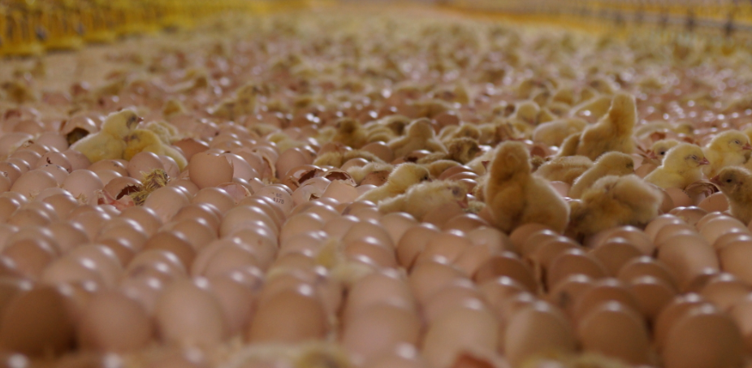
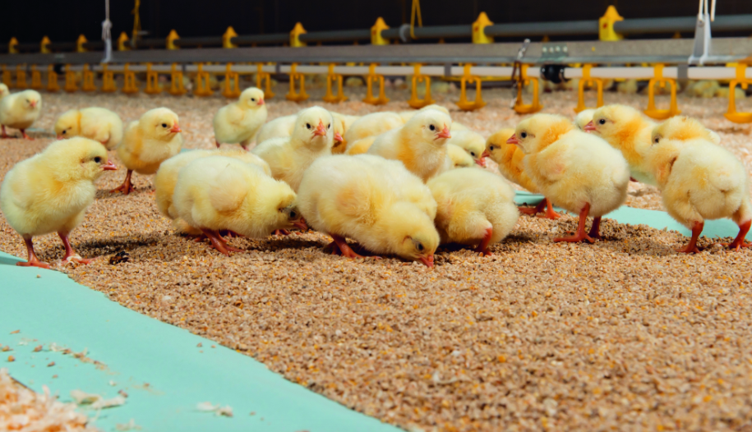
The chicks will hatch in a normal hatch window (24 – 36 hours), directly on the litter on the floor of the barn. This provides the same hatch window as a traditional hatchery, so the total process will not take any additional time to hatch the day-old chicks. The conditions will be completely different though than the multi-challenge environment of the hatchery.
The chicks will have direct and undisturbed access to feed, water and light right after hatching, more space and healthier temperatures. It's a more animal-welfare friendly way to hatch the chicks because all the hatchery handlings and chick transport that can lead to stress are completely eliminated. This results in a more robust and more healthy day-old chick that will perform optimally during the growing cycle of the bird in the barn.
Does this change the processing of day-old chicks? How does this concept affect vaccination?
Many vaccines can be applied in-ovo before the eggs are transferred to the barn. Some vaccines will still need to be applied through other methods such as instant spray vaccination, but it's perfectly doable to achieve the same level of protection by spraying that vaccine in the barn as it would be if it were applied in the hatchery.
Is this better for the chicks?
Yes, this is better for the welfare and robustness of chicks. One of the big challenges hatcheries face, is transporting the day-old chicks after they hatch – often quite far. By transporting the pre-incubated egg instead of the day-old chick, they will hatch in the environment that will be their final environment, where the grow-out also takes place.
Directly after hatch, they will familiarize with the barn (imprinting) and develop and target their immune system based on the conditions or challenges present in the barn. This provides a smoother start of the cycle and increases animal welfare, a better intestinal development, but it provides additional benefits during the entire broiler growing cycle.
What other benefits does NestBorn offer, and how is it different from other on-farm hatching technologies?
One of the biggest and most-known benefits is that with on-farm hatching, we have a good solution for an uninterrupted early feeding of the day-old chick. At the same time, we eliminate all other stresses (handling and transport) that can have an impact on the chick at the very important start of a cycle.
Our technology is different from other on-farm hatching systems because our system is highly accessible. The hatchery or the integration that acquires our NestBorn egg-placing machine, can use the machine to service many barns in one day and move it from farm to farm. Of course, the machine needs to be cleaned and disinfected in between farms, but it's still much more accessible.
Scaling up is easier to do with a system like ours because barns do not need any modification or specific equipment if they use NestBorn’s on-farm hatching system. Just the NestBorn machine going in and performing the service of placing the eggs on the litter bed placed on the floor. The process also does not create any waste on the farm.
With our system poultry companies are not required to leave behind the setter trays during the hatching process, so no requirement to have to come back to get those trays some days later. This resolves biosecurity concerns because hatcheries don’t like leaving behind setter trays in barns, it’s a much cleaner and labor-friendly way of doing on-farm hatching with NestBorn.
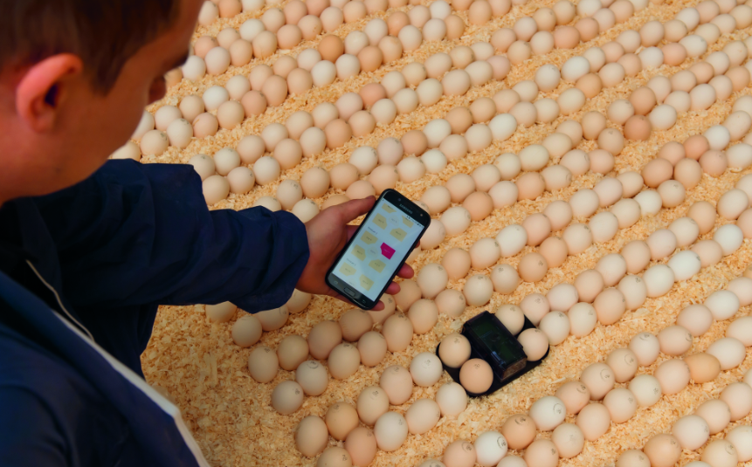
One additional thing that makes us different from other on-farm hatching systems is that we have eggshell and barn temperature-measuring equipment, and this information facilitates the on-farm hatching process. On the NestBorn web portal, all these barn conditions and eggshell conditions can be monitored in real-time, and it can be optimized during hatch to always have the right conditions for the egg to hatch into a robust day-old chick.
Does this machine save producers on labor costs?
Yes, this machine saves labor by eliminating from the hatchery some labor-intensive aspects of production related to chick take-off. The optimal model is to not work from a traditional hatchery anymore, but to work in what we call an “eggery” or “incubatory”.
An example is UK broiler integrator, Crown Chicken/ Cranswick, and they already transformed their hatchery into an eggery. It’s a very efficient, lean and clean set-up with only incubators, candling and in-ovo vaccination, with just eggs going in and going out. This model is very investment-friendly because you don’t need the size of a traditional hatchery, and at the same time you solve early feeding requirement. There’s no need for any of the hatchery equipment related to hatch and handling of day-old chicks.
At the same time, it’s more efficient in its use of energy and water (cleaning). It’s also helpful for saving on labor requirements and costs because all the chick handling is eliminated, which is a very labor-intensive process in the hatching of day-old chicks.
Many producers are looking for solutions to improve welfare and profitability. How do customers typically quantify the economic impact of the NestBorn system?
Our company aims to improve day-old chick welfare, quality and health and do so in a sustained, cost-efficient way for our customers. One of the advantages that our system offers to hatcheries or integrators that use our system is that it is very investment friendly.
The level of culling of the day-old chicks will be lower when chicks are hatched in a stress-free way on the farm. We also see better hatchability – more hatching eggs are transformed into a viable day-old chick. At the same time, we see lower mortality and lower utilization of antibiotics which is very important to farmers, but also for consumers and the entire society.
We see chicks that start in an optimal way will also perform better during the growing cycle. We see better technical performance, growth and feed conversion, low footpad dermatitis occurrence, and the farmer will benefit from this.
In the end, even the processor can benefit because working closely together with the hatchery can help produce a 24/7 hatch of these day-old chicks on the farm. They can hatch chicks at the base of the processing plant when they need birds for slaughtering on certain days of the week at a specific weight range. This improves uniformity by hatching on farms.
Overall, we see that there are financial gains from the hatchery to the grower to the processing plant. Ideally, in an eggery with an integrator, all these benefits add up in the same company.
Does this benefit the entire value chain?
Yes, and this technology is going to create a shift in the industry. We have a very strong system. We have key examples in three different continents. IPPE has been very interesting and has led to a lot of new contacts.
NestBorn is really looking forward to the future. We think we will be able to make a change from the traditional hatchery environment to a more future-proof hatching of day-old chicks.
Source: thepoultrysite.com