Poultry India, an advisory body with the primary mandate of spearheading the 'Eat Right, Eat Healthy' educational campaign, announced the launch of an all-India Protein Awareness Campaign — a national initiative to educate people on proteins' vital role in enhancing day-to-day health, fitness and general wellbeing.
Campaign Channels — Multi-Phase Outreach
The campaign will be conducted in several phases using diverse communication tools including road-shows, open house discussions with parents, teachers and school children in urban and semi-urban areas, town-hall meets with village elders and guardians. Poultry India will circulate printed material to retail outlets highlighting protein importance and consequences of its deficiency.
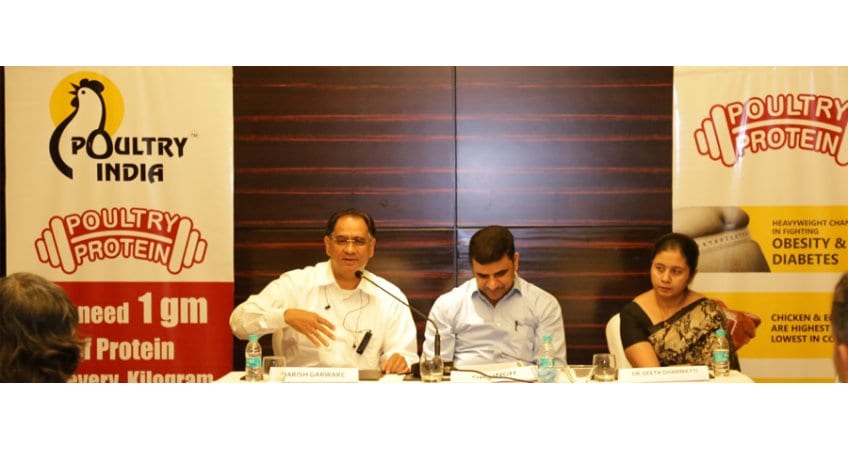 Launch of Poultry India's National Protein Awareness Campaign at Pune
The Scale of the Crisis
India houses 194.6 million protein-deficient and undernourished people, with 65 million children under age 5 stunted. Indian children are more malnourished and protein-deficient than their counterparts in sub-Saharan Africa. Protein-Energy malnutrition (PEM) in young children has reached near epidemic status, often resulting from consuming low-protein foods.
"At 194.6 million, India today houses the highest number of protein deficient people."
— Mr. Harish Garware, Executive Committee Member, Poultry India
"Protein cannot be stored. Your body needs it daily. In right quantities."
— Mr. Harish Garware, Poultry India
PRODIGY Survey — 80% of Indians Protein Deficient
The 'Protein Consumption in the Diet of adult Indians Survey' (PRODIGY) found 80% of all Indians are protein deficient. The survey covered 1,260 respondents across seven major Indian cities, concluding that 91% of vegetarians and 85% of non-vegetarians lack adequate protein. Weakness and fatigue are key symptoms.
Lifestyle diseases — obesity, diabetes, hypertension, and elevated triglyceride levels — could be addressed through increased dietary protein.
Diabetes & Demographic Outlook
The International Diabetes Federation estimated India's diabetic population at 65.1 million, with media reporting around 67 million diabetics in November 2013 — approaching the IDF's 2007 prediction of 69.9 million diabetics by 2025, arriving a decade early.
By 2030, India will have 1.6 billion people, increasing overall food demand. With roughly 60% of the population living in poverty, alongside a rising middle class and incomes increasing by 7-8%, demand grows for both quantity and quality food.
World Egg Day — October 9, 2015
The Government of India collaborates with Poultry India to promote World Egg Day on October 9, 2015, featuring a week-long program from October 3rd including essay competitions, cooking competitions, and awareness distribution through pamphlets, brochures, and recipe books.
"Everybody agrees that protein is good for the body. But very few, including…"
— Mr. Om Prakash Singh, Core Committee Member, Poultry India
"Indians consume only 37gms of protein a day which is a mere half of the recommended intake."
— Mr. Om Prakash Singh, Poultry India
Protein per 100g — Sources Compared
Daily protein intake should equal body weight in grams. Per WHO surveys, Indians consume only 37 grams daily — half the average Western intake.
| Item (per 100 g) | Protein (g) | Price (Rs approx.) |
|---|---|---|
| Egg | 13.2 | 8 |
| Chicken | 30 | 20 |
| Mutton | 26 | 40 |
| Milk (Full Fat) | 3.2 | 5 |
| Yogurt | 5 | 13 |
| Paneer (Full Fat) | 11 | 35 |
| Fish | 22 | 100 |
| Urad Dal | 24 | 12 |
| Moong Dal | 24.5 | 10 |
| Tur Dal | 22 | 11 |
Dal Alone Won't Do — Bean Digestion Limits
The campaign highlights various protein sources in readily available daily foods. Dal and beans provide protein and minerals like potassium and magnesium, but offer only moderate protein. Experts recommend limiting intake to 50–60 grams daily, yielding only 10–11 grams of protein — much less than the 1 gram per kilogram of body weight recommendation. A 70 kg person needs 70 grams of protein daily.
Dal contains ~25% protein and approximately 50% starch or high carbohydrates, explaining digestive difficulty. Beans contain trisaccharides difficult to break down (including oligosaccharides). Because beans contain both protein and starch requiring different digestive environments and enzymes, thorough digestion becomes difficult — while protein digests, starch ferments in the stomach, producing gas and toxins.
"Given the risk low protein levels pose to the health of Indians, spreading protein evenly across meals is essential."
— Dr Geeta Dharmatti, nationally acclaimed nutritionist
"Consumption of adequate protein ensures strong immune defense, efficient nerve signalling, healthy hair, and fluid balance maintenance."
— Dr Geeta Dharmatti, nutritionist